Training methods and planning
Optimising the Training of Weightlifters During Time-Zone Adaptation
English summary of Tyazhelaya Atletika. Ezhegodnik 1986 (Moscow: Fizkultura i Sport, 1986), pp. 15–17: the text is paraphrased, not translated; figures are the original images.
A change of geographical zone by 4–7 hours or more reshapes the daily physiological rhythm, which affects every function. An abrupt change of time regime restructures all body systems, lowers working capacity and can cause pathological states; in athletes it impairs coordination and results.
Over several years the author studied highly qualified lifters travelling to competitions with a 5–7 hour time difference. After a 7-hour shift, vegetative functions (blood pressure, heart rate, body temperature) returned to baseline on days 5–8, and motor functions (maximal deadlift strength, muscle sense, coordination) on days 8–10. A 5-hour shift gave similar changes. To speed recovery, the study set out to plan training, choose means and methods, fix a regime of activity and monitor athletes before and after the journey; the shift and the need to compete at a fixed time make this difficult.
V. L. Yaroslavtsev recommends arriving 10–20 days before the start, or changing the training schedule before departure: afternoon training before going west, morning training before going east. Athletes in form are less sensitive to rhythm changes and adapt faster, so the main task is to reach form before departure and keep it. As the restructuring depends on the athlete's muscular activity, a regime suited to ordinary conditions does not suit an abrupt time change.
From the literature and their own experience the author modelled a new pre-competition regime. Fig. 1 gives three schemes (A, B and C) for distributing load, as a percentage of total volume, over the four pre-competition weeks; deviations of 2–4 % are acceptable.
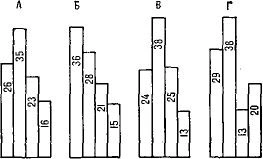
For the “acute readjustment” stage, the first 5–7 days after the flight, scheme D was drawn up from scheme C by exchanging the volumes of the 3rd and 4th microcycles, after cutting the 4th by 5 % and raising the 1st correspondingly, since the last week of the previous mesocycle was a recovery week.
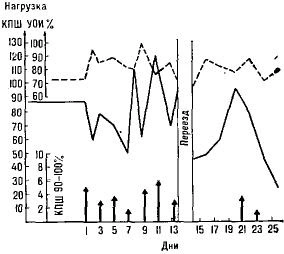
Fig. 2 shows the volume as number of lifts, the average relative intensity (AvRI) and the lifts at 90–100 % of maximum in the classical exercises. In the third microcycle intensity was lowered, mainly through assistance exercises affecting coordination, and no lifts of 90–100 % were made, preventing overstrain of the adaptation mechanisms. The mesocycle followed the scheme of E. A. Grozin and co-authors (1982): two microcycles of preparation before the flight, one of acute readjustment, one of recovery, then the competition. Volume and intensity followed A. V. Chernyak's method.
The experiment ran in 1983 for 28 days (14 before and 14 after the flight) with eight highly qualified lifters of the Khabarovsk regional Burevestnik team, travelling to a region 5 hours apart. Before the flight they trained from 20:00 and went to bed and rose 2 hours later than usual; afterwards they trained from 17:00 in the acute stage and from 11:00 and 17:00 in recovery, the times of their competition. Schisandra extract, vitamins, massage and sauna were used throughout. Recovery was tracked by hand-grip and deadlift dynamometry, tensometry, motor-analyser sensitivity, strength endurance, heart rate, blood pressure, temperature, photography of the bar path and subjective sensations.
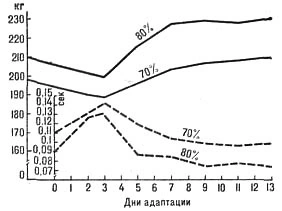
The main motor and vegetative functions recovered earlier than with the usual load distribution, without a sharp fall afterwards. Motor-analyser sensitivity measured in the evening fell most on day 3 and recovered on day 5, and the morning figures on day 4. Snatch-pull force and time were measured in the initial acceleration, at the knee movement and in the final acceleration; the averages in Fig. 3 recovered on days 5–6 and other indices on days 4–7. Motor functions recovered faster in the morning, vegetative ones in the evening. Insomnia, night hunger, lethargy and reluctance to train disappeared by days 5–6. At the competition six lifters improved their two-event total by 10–17.5 kg and only two fell short of their best, by 2.5 and 5 kg.