Training methods and planning
Prerequisites for Developing a System for Managing the Long-Term Training Process
English summary of Tyazhelaya Atletika. Ezhegodnik 1986 (Moscow: Fizkultura i Sport, 1986), pp. 10–14: the text is paraphrased, not translated; figures are the original images.
Sports science aims at a system of long-term training as a whole, constantly developing object, and at effective ways of managing it. In weightlifting this system can be presented as the process of developing sporting mastery (PSSM), whose length is relatively stable and which has clearly marked stages.
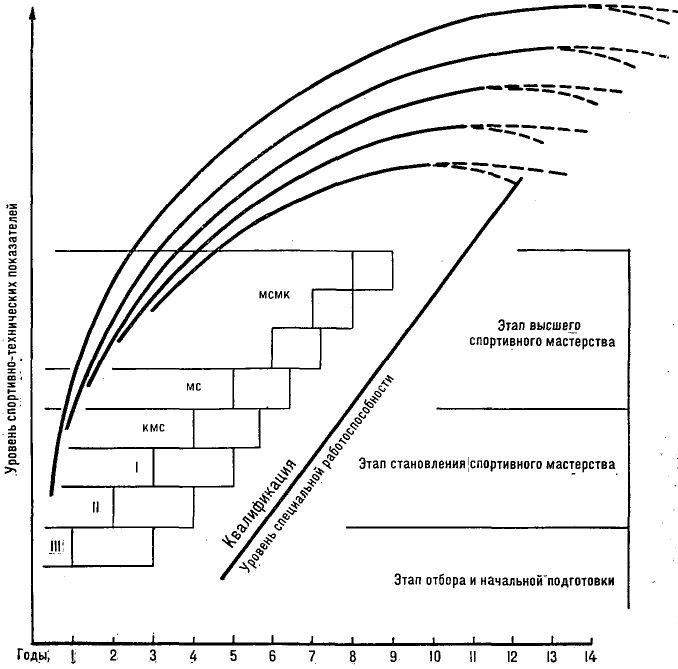
Performance indices progress for about 12 years on average (10 to 14). Lifters meet the Master of Sport standard in about 5 years and need 2–3 more to reach international class. Each step of the all-Union classification (third, second and first class, Candidate Master, Master) takes about a year, and lighter lifters pass them somewhat faster than heavier ones.
The PSSM comprises selection and initial training, formation of sporting mastery, higher sporting mastery, and preparation in the national squad. Each stage has its own tasks, and only when they lead to a high result is the process a true system that lets each lifter's potential be fully used.
The stages
Selection and initial training lasts up to 2 years. The athlete masters the basics of technique, gets used to training and passes the first steps up to third class. Errors made here are hard to correct later: underrating all-round preparation, neglecting technique, forcing the training, and above all “drilling” for results instead of systematic preparation, which disturbs psychological, functional and physical development. Every beginner, however gifted, needs broad initial training, and up to 40 % of the time should go to general physical preparation (GPP).
Formation of sporting mastery lasts up to 3 years and aims at the Candidate Master standard. The lifter must learn to snatch and clean and jerk correctly and make the technique a firm skill. The volume of classical lifts is larger than before, especially on the way to second and first class, and falls near the Candidate standard. GPP takes up to 20 %.
Higher sporting mastery lasts up to 4 years, aiming at the Master and international-class standards. Special assistance exercises dominate, with much attention to speed-strength qualities; technique is improved or maintained, and GPP takes 16–17 %.
The highest step is competing in national squads, where the athlete endures heavy physical and mental loads and must show international-level results under extreme competitive conditions. Training is structured much as in the preceding stage.
Structure and programming
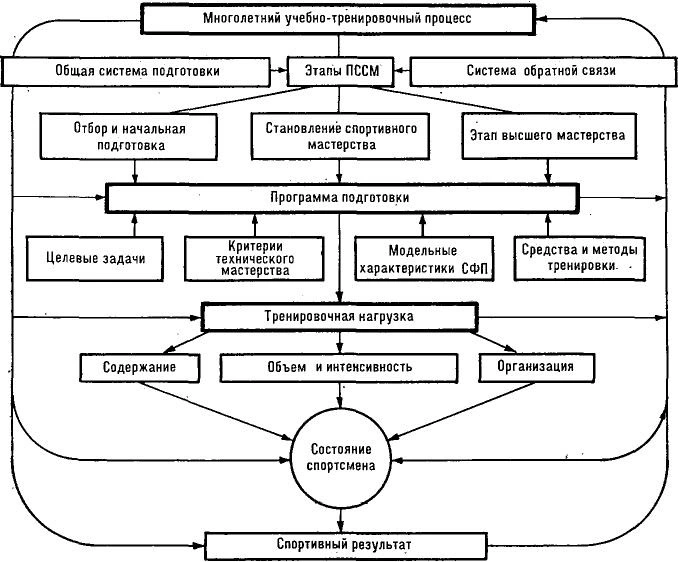
The PSSM advances by planned, consistent raising of specific working capacity, so improving technique requires a growing training effect and managing preparation requires knowing the structure of the long-term process (Fig. 2). Each stage needs a concrete programme defining the means (main, supplementary and GPP), the biomechanics of the snatch and of the lift to and from the chest, and the methods of speed-strength work, together with a load volume distributed rationally across periods. With a rational structure the lifter can regulate his fitness and improve technique.
Much scientific and methodological material, chiefly on volume and intensity, has accumulated, so coaches must keep updating their knowledge, and the shortage of highly qualified coaches grows. Recommendations come from top specialists but are applied by less prepared coaches, while the leaders lack time. Unified programmes for each stage are therefore needed, built on the laws of the PSSM and setting exercises for all athletes, corrected for individual features. In 1975 A. S. Prilepin successfully tested a lesson-by-lesson 10-week programme for second-class lifters, and the author published three-week programmes for introductory, base and pre-competition cycles for leading lifters in the 1978, 1980, 1981 and 1983 yearbooks, tested in a long experiment with the Dynamo national teams.
Moving from planning to programming improves management because operational, current and long-term planning and control change in principle (Fig. 2). First a target is set: growth of the sporting result, the main index of effectiveness, forecast from the lifter's qualification. A preparation programme then selects means, methods and optimal volume and intensity to reach the level of special working capacity that makes the target attainable,. As it is carried out, the athlete's functional level rises. Feedback supplies regular information on his condition so the programme can be corrected in time. The result indicates both effectiveness and qualification and feeds the next target. The athlete is the central figure, since target and programme are set for him.
The whole process must be seen as a unit, with annual cycles as interrelated subsystems. A long-term yearly plan (no more than 4 years ahead) forecasts chiefly the result and sets total load by month and year and approximate intensity. Monthly volume is then divided by weeks, means are chosen for the week and each session, the time for heavy work (at least 90 % of maximum) is roughly fixed, and operational planning follows. The rational load structure emerges only in training, and one can judge it after a month, not a week, so under such planning errors surface at the end of a stage, when nothing can be changed. Practice shows that effectiveness rises markedly with programming, which fixes in advance the sets, lifts and weight of each exercise and session for at least 3 weeks.
A programme has several functions. It is a matrix with an optimal set and distribution of means, methods and loads, under which specific performance improves and the target is met at each stage. It is also a means of control, keeping training within limits and preventing unjustified departures from load-planning principles. And through feedback the load is corrected individually and the programme and forms of planning, especially operational planning, are improved. Unified programmes thus encourage a creative approach, and combined with correction they let each athlete's potential be more fully realised.