Technique of weightlifting exercises
Rapid Correction of Weightlifters' Technique with a Computer
English summary of Tyazhelaya Atletika. Ezhegodnik 1986 (Moscow: Fizkultura i Sport, 1986), pp. 5–7: the text is paraphrased, not translated; figures are the original images.
Weightlifting uses a growing number of devices that record the movement of the athlete and the bar, and modern equipment can analyse many parameters at once. Yet during training the lifter receives only a small part of this information. Processing records is laborious, so a detailed analysis of even one lift arrives at the end of the session at best, and comparing it with a chosen model may take a specialist long work. Computers and microprocessors open fundamentally new possibilities for national squads and physical-education students, and later for more athletes.
Microcomputers are compact, fairly easy to operate, hold tens or hundreds of thousands of numbers, and have external memory, good speed and high-level languages, enough for most training tasks. To correct technique during training, the machine must take data from sensors, process, analyse, output and store the results before the exercise is repeated, that is, in real time. The authors' devices perform tens of thousands of operations per second and give results in 1–2 s for a simple analysis or a few seconds for a detailed one; without such speed, analysis between sets is impossible.
The article describes the first work on rapid computer correction of technique, carried out at MOGIFK under Prof. A. N. Vorobyov, Dr. Sc. (Medicine). The automated system for express analysis of the biomechanics of lifts, tested successfully, is called “Atlet”. It processes, stores and analyses results and shows or prints them.
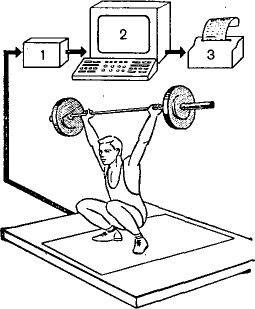
The base is the industrial SPP-2 complex: an Elektronika DZ-28 microcomputer with display and printer. Force data come from a PD-3 strain-gauge platform connected through an F7077/1 analogue-to-digital converter. The authors added a converter interface, a timer and an I/O bus expander (built by L. N. Furaev, A. V. Diev and S. V. Prishchepov). On the computer's command the converter digitises the platform signal every 0.005 s, the values are stored, and after the movement a prepared program processes them and gives results numerically and graphically.
The first programs cover characteristics common in research and give, within seconds:
- time and rhythm of the movement;
- extreme values of the dynamic characteristics;
- force impulses in separate phases;
- derived indices (force gradients, various coefficients);
- work and power;
- force–time graphs, among others.
Of particular interest is the quick comparison of a lift with any earlier lift held in memory. It can also reveal trends in individual indices during a session, in effect a small research study done in seconds.
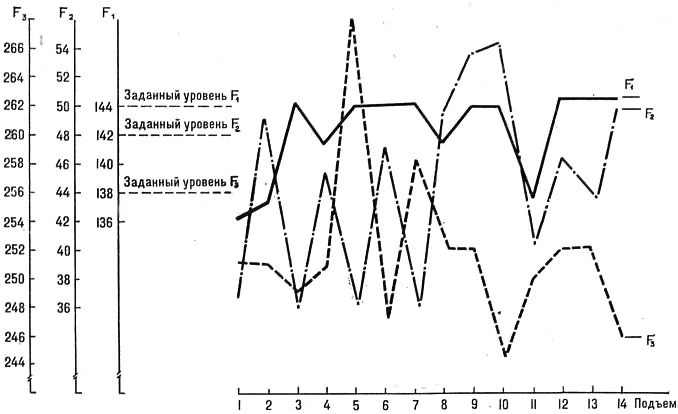
Fig. 2 shows correction of the force extremes of Candidate Master of Sport K. in one session. He approached the bar 7 times at 80 % of maximum, snatching twice each time. The program, based on earlier detailed examination, asked him to aim at set levels of the three force extremes F1, F2 and F3 (the usual designations in the work of A. A. Lukashev, V. I. Frolov and others); maximum force was measured to within 2 kg. Control of force at different moments of the movement proves uneven, and coach and specialist can obtain further information for correction. Systems of the “Atlet” type thus give new ways of coordinating the work of the researcher and the coach.