Technique of weightlifting exercises
The Clean and Jerk Technique of the Bulgarian Lifter Aleksandr Varbanov
English summary of Tyazhelaya Atletika. Ezhegodnik 1986 (Moscow: Fizkultura i Sport, 1986), pp. 7–10: the text is paraphrased, not translated; data tables are given in full with English labels; figures are the original images.
The article analyses the clean and jerk of Aleksandr Varbanov (75 kg class) at the 1983 world championships, where he jerked 210 kg for a world record and failed with 212.5 kg. Figures and tables show the technique, bar path and temporal characteristics; values are quoted for 210 and 212.5 kg respectively.
The pull and the catch
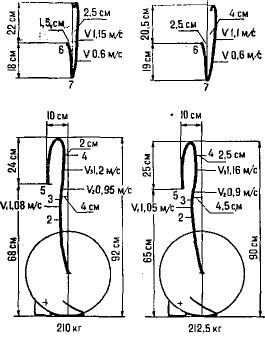
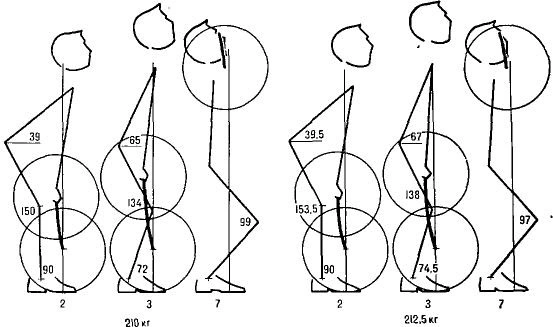
In the first pull Varbanov lifts the bar by driving the legs straight while extending the trunk, whose inclination grows from about 30° to 39°, against an average of 32° in other top lifters. The shoulders move up and slightly forward. He stops the leg drive at knee angles of 150° and 153.5° (as other leaders do), with vertical shins, hip angles of 99° and 103°, and the shoulders 8–10 cm ahead of the bar, which is just above the knees at 49–51 cm. Pre-acceleration peaks at 1.08 and 1.05 m/s at 57 and 56 cm, with a maximum acceleration of 4.2 and 4 m/s².
The second pull starts with bringing the knees under the bar in 0.12 s, bending them to 134–138° (125–130° in other leaders). The bar is then at mid-thigh, 60–61 cm, above mid-foot; the shoulders are 5 and 4 cm ahead of it, and trunk and shin inclinations are 65° and 67°, and 72° and 74.5°. The final acceleration takes 0.17 and 0.16 s, and bar speed rises to 1.2 and 1.16 m/s. The bar first comes 4 and 4.5 cm towards him, then finishes 2 and 2.5 cm behind its starting vertical.
He remains on his toes for 0.11 and 0.09 s after the final effort, and the unsupported part of the squat lasts 0.13 and 0.12 s. The feet are spread and placed 3–4 cm forward as the bar reaches its maximum height of 92 and 90 cm. In the amortisation (0.41 and 0.33 s) it drops 24 and 25 cm and is fixed on the chest at 68 and 65 cm. Bar speed and height are somewhat below other leaders of his height (159 cm), who average 95.5 cm; the amortisation is average.
The 212.5 kg clean was harder. The bar rose only to 90 cm and he could not restrain its pressure, so it fell 25 cm and was fixed at an unusual 65 cm. He relaxed the lower back and lowered the pelvis about 3.5 cm more (buttocks 7.5 and 4 cm from the platform), which made standing up harder. The dynamics of both lifts were otherwise nearly identical, except that in the second he did not reach equal acceleration in the two pulls.
The jerk from the chest
In the dip Varbanov leans slightly, moving the common centre of gravity and the bar forward 1.5 and 2.5 cm. The dip is 18 and 19 cm deep, with knee angles of 99° and 97° against an optimum of 100–110°, and lasts 0.46 and 0.5 s. Descent speed rises to 0.6 m/s and then falls as he brakes and stops the bar, which moves 9.5 and 10 cm before braking; his braking path of 8.5 and 9 cm is much longer than other leaders'. Coming up he leans forward, so the bar moves up and forward by 3.5 and 4 cm. After a pause of about 0.04 s he drives it upward. Peak acceleration (6.5 and 6.4 m/s²) comes just after the stop, when the bar has moved 1–2 cm, and peak speed (1.15 and 1.1 m/s) at 1.5 and 2.5 cm; he drives much more slowly than other top lifters of his height.
He then sends the trunk down and spreads the legs. The bar is driven 22 and 20.5 cm in about 0.46 s. In the split the front foot goes 28 cm forward with 210 kg but only 23.5 cm with 212.5 kg, against 28–30 cm typical for his height. He finishes by straightening the legs and fixing the bar on straight arms.
Why 212.5 kg failed
He did not stop the bar in the dip in time at optimal knee angles. The angles were too acute, so the drive lacked force, and the braking path had to be lengthened (the shorter it is, the greater the effect). A lifter of 159 cm needs a drive of at least 22 cm to fix the bar in the split, and Varbanov managed only 20.5 cm. The forward shift in the dip had already minimised the stability angle towards the toes, and with the front foot too little forward the bar ended ahead of the centre of gravity.
Table 1. Spatial and temporal characteristics of Varbanov's clean and jerk
| Characteristic | Weight, kg | |
| 210 | 212.5 | |
| Time of bar pre-acceleration, s | 0.52 | 0.53 |
| Maximum acceleration during pre-acceleration, m/s² | 4.2 | 4.0 |
| Bar speed after pre-acceleration V1, m/s | 1.08 | 1.05 |
| Bar displacement until V1 is reached, cm | 57 | 56 |
| Time of bringing the knees under the bar, s | 0.12 | 0.12 |
| Bar speed while bringing the knees under the bar, m/s (V2) | 0.95 | 0.9 |
| Bar displacement until V2 is reached, cm | 65 | 64 |
| Bar movement towards the lifter while bringing the knees under, cm | 4 | 4.5 |
| Time of the final part of the second pull (from the end of the knee movement), s | 0.17 | 0.16 |
Table 1 (continued)
| Characteristic | Weight, kg | |
| 210 | 212.5 | |
| Time of the final effort (V2 to V3), s | 0.1 | 0.09 |
| Maximum acceleration in the second pull, m/s² | 3.4 | 2.6 |
| Maximum speed in the second pull, V3, m/s | 1.2 | 1.16 |
| Bar displacement until V3 is reached, cm | 75 | 74 |
| Bar shift towards the lifter in the second pull relative to its starting position | 2 | 2.5 |
| Possible bar flight height, cm | 82.5 | 80.8 |
| Actual bar lift height, cm | 92 | 90 |
| Duration of the unsupported phase of the squat, s | 0.13 | 0.12 |
| Duration of the amortisation part of the squat, s | 0.41 | 0.33 |
| Amount of amortisation in the squat, cm | 24 | 25 |
| Height at which the bar is fixed in the squat, cm | 68 | 65 |
| Bar shift towards the lifter in the squat relative to its starting position, cm | 10 | 10 |
| Forward shift of the feet when spreading them in the squat, cm | 3 | 4 |