Equipment and training apparatus
Shock-Absorbing Weightlifting Platforms
English summary of Tyazhelaya Atletika. Ezhegodnik 1986 (Moscow: Fizkultura i Sport, 1986), pp. 36–38: the text is paraphrased, not translated; figures are the original images.
A platform must give the lifter a firm footing and protect the building. Under the 1933 rules the boards had to be at least 45 mm thick, which sufficed when barbells were mostly up to 110 kg and training less intense. As the weights grew, so did the thickness, now 140 mm and set to rise further. Yet by the 1960s thickness alone had proved inadequate: falling barbells sometimes wrecked a platform within one competition, and heavier platforms cost more and were awkward to transport and assemble. Dropped heavy weights also cause vibration, harmful to lifters over time and to the building, so training and contests are confined to ground floors with solid foundations.
Until the 1970s all discs were metal, and the crash of a dropped barbell impaired human performance and often caused occupational hearing disease in veteran coaches and lifters. Shock-absorbing materials were therefore introduced, and training moved outdoors in fine weather. Porous fillers placed in a pit under the boards soon compacted under load and lost their effect. Next came a platform with a sand pit and two concrete cushions under the spots where the bar lands, with rubber inserts on top (E. N. Khotimsky, 1970). It protected building and boards only when the bar landed on those spots, and did not remove noise. Such platforms remain widespread, but their bulk keeps them out of multipurpose arenas.
The authors built and tested a platform with hollow car tyres in the pit under the boards. Vibration and noise fall sharply because the tyres deform and expel air, dissipating the energy. But the boards on the springy tyres oscillate so much, and add to the lifters’ movements, that the design cannot serve in official competitions. Rubber-coated discs were expected to solve this, but boards still broke and noise and vibration, though reduced, remained; the rebound grew, so the barbell often flew off the platform. The 1975 rules therefore forbade releasing a rubber-disc barbell before it crossed an imaginary line at waist level; but a lifter who loses control of it may still wreck the platform or injure himself or the chief referee.
Allowing for these faults, staff of the Kazakh Institute of Physical Culture and the All-Union Institute of Sports and Tourism Goods (VISTI) devised a hydraulic platform designed to withstand heavy blows and absorb the energy that makes noise and vibration (author’s certificate No. 895472, 1982). It comprises a wooden deck 1 with rubber inserts 2, set in a wooden frame 3 containing a hydraulic layer 4 of many elastic vessels 5 (see the figure). Their walls are synthetic, box-shaped and water-filled, and the deck edges 6 and frame perimeter 7 carry a low-friction coating.
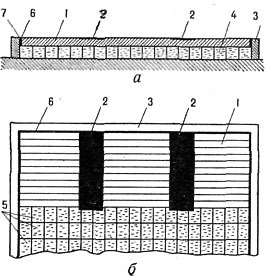
When a barbell hits the floating deck, the force spreads evenly over the whole hydraulic layer and the elastic properties of water absorb it. The vessels keep the deck level under uneven loading, and their walls offer more surface than one vessel of equal volume, aiding dissipation. Water is practically incompressible, so the vessels, inside a rigid frame and deck, keep their shape and prevent the large oscillations that could hurt results.
Exact dimensions can be fixed only once a prototype, being made at VISTI, exists. If it is built promptly and tested successfully, VISTI could soon supply a compact, portable, universal platform, cheaper in mass production than present ones and far more durable.